Off-grid solar system setup (2025): cost & DIY guide
Living off the grid is no longer reserved for remote cabins or rugged survivalists. With advances in solar technology and falling equipment costs, setting up a reliable off-grid solar system has become an achievable project for homesteaders, RV travelers, and even suburban homeowners seeking energy independence.


Whether you’re planning to power a small cabin or create a fully self-sustaining energy system for your homestead, this guide will walk you through the full setup process. You’ll learn what components are essential, how much it realistically costs in 2025, and how to build a system that fits your needs—with or without hiring a contractor.
Why choose an off-grid solar system?
An off-grid solar system generates and stores electricity independently from the public power grid. This means no monthly utility bills, no blackout concerns, and full control over your energy supply.
Key advantages:
- Total energy independence: No reliance on utility companies
- Ideal for remote areas: Power where no grid connection is possible
- Sustainable living: Reduce your carbon footprint with clean energy
- Long-term savings: Avoid rising electricity costs
Is it right for you?
Going off-grid requires planning, a realistic understanding of your energy needs, and a willingness to maintain your own system. If you’re already focused on self-sufficiency or homesteading, it’s often a perfect match.
How off-grid solar systems work
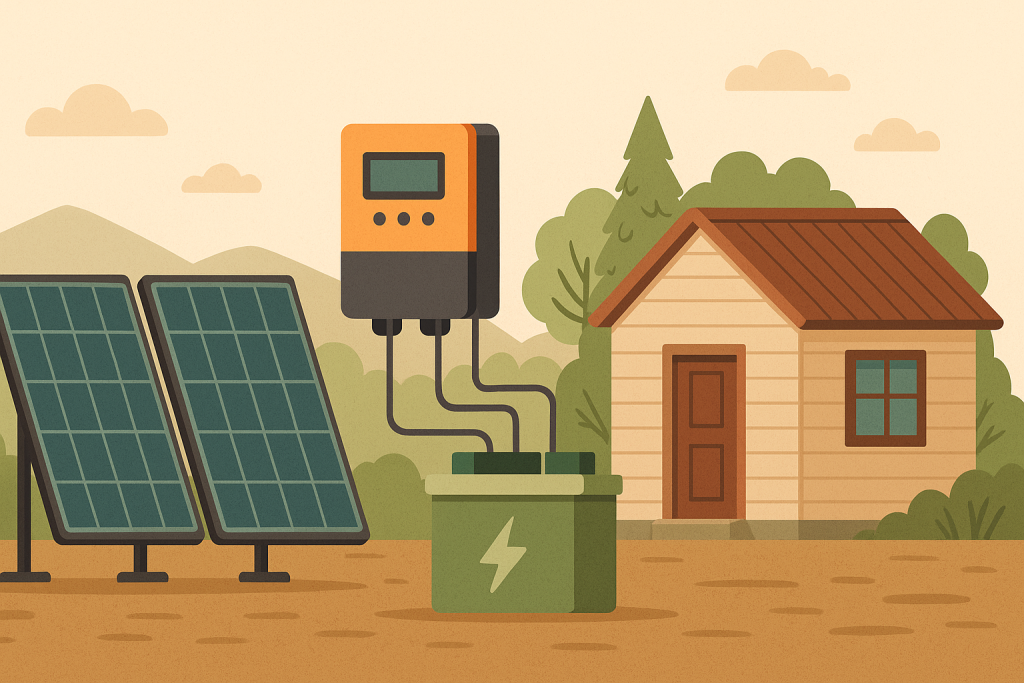
An off-grid system produces electricity using solar panels and stores it in batteries for later use. When the sun isn’t shining, you use stored energy from the battery bank.
Main process flow:
- Sunlight hits the solar panels
- Panels convert solar energy into direct current (DC) electricity
- A charge controller manages the power going to the batteries
- Batteries store energy for later use
- An inverter converts DC electricity into AC power for your appliances
Each component plays a crucial role. In the next section, we’ll break them down in detail.
Essential components of an off-grid solar system

Let’s explore each part of the system and what to look for when choosing the right hardware.
1. Solar panels
These are the heart of your system. You’ll need panels that match your power needs and available space.
- Types:
- Monocrystalline (most efficient, long-lasting)
- Polycrystalline (cheaper, slightly less efficient)
- Thin-film (flexible but low efficiency)
- Average cost in 2025:
$0.80 to $1.20 per watt - Example:
A 3,000-watt array might cost around $2,400 to $3,600 in panels alone.
2. Charge controller
This regulates how much power goes into your battery bank and prevents overcharging.
- Types:
- PWM (cheaper, less efficient)
- MPPT (more expensive, higher efficiency, especially in variable light)
- Average cost:
$100 to $400 depending on size and type - Tip: Always choose an MPPT controller for better energy harvest.
3. Battery bank
This stores your electricity for nighttime and cloudy-day use. It’s the most important and most expensive component.
- Types:
- Lead-acid (cheapest, shorter lifespan, more maintenance)
- Lithium-ion (expensive upfront, lasts longer, less maintenance)
- Average cost (2025):
- Lead-acid: $100 per kWh
- Lithium: $300–$500 per kWh
- Example:
A 10 kWh lithium battery bank may cost around $4,000
More key components for your off-grid system
4. Inverter
Most household appliances use alternating current (AC), but solar panels and batteries produce direct current (DC). The inverter is what converts DC to usable AC electricity.
- Types:
- Pure sine wave (compatible with all electronics, more expensive)
- Modified sine wave (cheaper, not ideal for sensitive devices)
- Average cost in 2025:
$300 to $2,000 depending on capacity and quality - Tip: Go for pure sine wave inverters, especially if you’ll run refrigerators, computers, or power tools.
5. Wiring, fuses, and breakers
Your system needs safe and efficient wiring to connect all components, along with protection from short circuits or overloads.
- What you’ll need:
- Copper wire (gauge depends on voltage and distance)
- Fuse blocks and inline fuses
- AC and DC disconnects
- Grounding rods
- Estimated cost:
$300 to $600 depending on system size - Tip: Never underestimate wiring—bad wire sizing is one of the top reasons off-grid systems fail.
Tools and hardware required for DIY installation

You don’t need to be a licensed electrician, but you do need the right tools and a strong understanding of basic electrical safety.
Basic tools
- Cordless drill and bits
- Multimeter (for voltage and current testing)
- Wire stripper and crimper
- Wrenches and screwdrivers
- Ladder and safety harness (for roof installs)
- Torque wrench (for battery terminals)
Optional tools
- Solar panel tilt mount
- Stud finder (for wall-mounted components)
- Thermal camera (to identify hot spots)
Sample system setup and total cost in 2025
Let’s break down the total cost of common off-grid solar setups this year, including all components and hardware.
Small cabin or van (400–800 Wh per day)
- 2 × 200W panels = $400
- 40A MPPT charge controller = $150
- 2 kWh lithium battery = $800
- 1000W pure sine inverter = $300
- Wiring, fuses, mounts = $300
Total = around $1,950
Medium homestead (3–5 kWh per day)
- 8 × 400W panels = $3,200
- 60A MPPT controller = $350
- 10 kWh lithium battery = $4,000
- 3000W inverter = $1,000
- Mounting, wiring, protection = $800
Total = around $9,350
Large off-grid home (10–15 kWh per day)
- 20 × 450W panels = $9,000
- Dual 80A MPPT controllers = $700
- 20 kWh lithium battery bank = $8,000
- 6000W inverter system = $2,000
- Professional installation = $3,000 (optional)
- Mounts, wiring, tools = $1,500
Total = around $24,200
Step-by-step installation guide (DIY)

1. Calculate your energy needs
Before buying anything, estimate how much electricity you use daily. List your appliances and how many hours per day each one runs. This determines the size of your system.
- Example:
- LED lights (40W × 4h) = 160Wh
- Refrigerator (150W × 8h) = 1,200Wh
- Laptop (60W × 5h) = 300Wh
→ Total = 1.66 kWh/day
Use an online calculator or spreadsheet for accuracy.
2. Choose and purchase components
Based on your energy needs, buy solar panels, batteries, charge controller, inverter, and wiring. Stick with reputable brands and check warranties (most panels have 25+ years of coverage).
3. Mount the solar panels
- Install panels on a south-facing roof (in the northern hemisphere) or on a ground-mounted rack.
- Ensure the tilt angle matches your local latitude for year-round efficiency.
- Secure panels using stainless steel brackets and waterproof roof seals.
4. Install charge controller and batteries
- Mount your charge controller close to the battery bank, in a cool, ventilated area.
- Connect solar panels to the charge controller using MC4 connectors and the appropriate gauge wire.
- Wire the controller to the batteries, being mindful of polarity and fusing.
- Ground the battery bank and install disconnects.
5. Install the inverter
- Mount your inverter near the battery bank but in a well-ventilated space.
- Use heavy gauge cables (short and thick) for DC battery connections.
- Wire the AC output to a breaker panel or directly to key appliances, depending on your setup.
6. Connect and test
- Double-check every connection before turning anything on.
- Use a multimeter to verify voltage at each stage.
- Power on your system and monitor the charge controller and inverter displays.
Mistakes to avoid when going off-grid
- Undersizing the battery bank: Many DIY systems fail because there’s not enough storage to cover cloudy days or overnight use.
- Overloading the inverter: Make sure your inverter’s wattage exceeds your total load, with a safety margin.
- Inadequate ventilation: Batteries and inverters generate heat. Always allow airflow around them.
- Improper grounding: Ground all components to avoid electrical hazards and improve lightning protection.
- Mixing mismatched panels or batteries: Always use components with compatible voltages and chemistry.
Maintenance tips for long-term performance
- Monthly checks: Clean panels, check battery voltage, inspect wires.
- Battery care: For lead-acid, check water levels. For lithium, avoid deep discharges.
- Panel cleaning: Dust and bird droppings can reduce output by 10–20%. Clean panels with a soft brush and water.
- Software monitoring: Many modern charge controllers and inverters offer Bluetooth or Wi-Fi apps for real-time stats and alerts.
Choosing the right battery type for your needs
Lead-acid vs lithium
| Feature | Lead-acid | Lithium-ion |
|---|---|---|
| Cost | Lower upfront | Higher upfront |
| Lifespan | 3–5 years | 10+ years |
| Maintenance | Requires water checks | Maintenance-free |
| Depth of discharge | ~50% | 80–90% |
| Weight | Heavier | Lighter |
| Cold performance | Less efficient | Better performance |
- Choose lead-acid if you’re on a budget and okay with regular maintenance.
- Choose lithium if you want long-term reliability and minimal upkeep.
Off-grid vs grid-tied vs hybrid: what’s the difference?
- Off-grid: Fully independent, requires storage, ideal for remote areas.
- Grid-tied: No batteries, feeds excess power back to the grid, no backup in outages.
- Hybrid: Combines solar with the grid and batteries—best of both worlds but more expensive.
Common configurations for different lifestyles

Full-time homesteader
- 12–20 kWh battery bank
- 5–10 kW solar array
- Backup generator (optional but recommended)
Cabin or weekend use
- 2–4 kWh battery
- 800–1200W solar
- Minimal inverter setup
Mobile/RV setup
- 1–2 kWh battery
- 400W foldable solar panels
- Lightweight inverter and compact charge controller
Generator backup: do you need one?
While solar and batteries cover most needs, a backup generator is useful during prolonged cloudy weather or winter months.
- Types:
- Gasoline (common, loud)
- Propane (cleaner, easier storage)
- Diesel (fuel-efficient, heavy-duty)
- Best brands:
Honda, Champion, Westinghouse, Generac - Use case:
Set it to auto-start when battery voltage drops too low, or use manually during off-seasons.
How to expand your system later
Start small and grow your system over time by:
- Adding more solar panels (check your charge controller capacity)
- Adding more batteries (use same type and voltage)
- Upgrading the inverter (plan space in advance)
- Reinforcing your mounting system for higher loads
Always size wiring and fuses for future expansion to avoid costly rewiring.
Sample DIY solar system wiring diagram (how to build a solar system off grid)
Solar panels → charge controller → battery bank → inverter → appliances ↓ grounding rodUse fuses and disconnects between each major connection. Always follow proper wire sizing based on voltage and distance. Label every cable for future maintenance.
Real-life case study: small homestead setup
Location: Northern Arizona
System size:
- 10 × 400W panels (4,000W total)
- 10 kWh LiFePO4 battery bank
- 60A MPPT charge controller
- 3000W pure sine inverter
Use case: Runs lights, fridge, chest freezer, laptop, fan, water pump
Cost (2025):
- Panels: $3,600
- Battery: $4,200
- Inverter: $1,100
- Controller: $350
- Wiring & mounts: $700
Total: ~$9,950
Result: Fully autonomous for 10 months/year. Generator used ~3 days in winter.
Tips to reduce cost without sacrificing quality
- Buy panels in bulk or during warehouse sales
- Use second-hand or refurbished batteries (verify cycles)
- Do all labor yourself, but get electrical advice if unsure
- Skip smart features unless really needed
- Mount on ground instead of roof to save time and risk
Is it difficult to install an off-grid solar system?
Installing an off-grid solar system in 2025 is more accessible and cost-effective than ever before. With a modest budget and the right information, you can power your home, cabin, or homestead completely independently.
From calculating your needs to selecting high-quality components and wiring everything safely, this guide gives you the foundation to build a system that works—and grows—with you. Whether you’re looking to escape rising energy bills or create a resilient homestead, solar power puts control back in your hands.