Amish secret to growing food: why the Amish gardening method is so effective
Rooted in tradition, not technology
Walk down any rural lane in Amish country, and you’ll notice something striking. No tractors rumbling. No buzzing power tools. Just quiet focus, calloused hands, and rows of vegetables that look like they’ve been growing there for centuries. The Amish have been cultivating abundant food in small spaces long before “self-sufficiency” became a modern trend. Their secret? It’s not some gadget or viral hack. It’s a deep commitment to simplicity, patience, and knowing the land like an old friend.

Unlike most of us, the Amish don’t rely on industrial solutions. They rely on systems passed down over generations techniques fine-tuned not with apps, but with experience. They’ve mastered how to grow a year’s worth of food using only small garden plots, hand tools, and wisdom you can’t buy at the store.
Their approach is a powerful reminder that less really can be more especially when it comes to growing food.
Simplicity, efficiency, and consistency
The Amish way works because it focuses on what truly matters. Good soil. Reliable crops. Seasonal rhythms. Their methods are intentionally low-tech, but highly efficient. For example, instead of wasting space with scattered plantings, they use compact layouts with precise crop rotations. Instead of synthetic fertilizer, they feed their soil with composted manure and cover crops.
There’s no rush in Amish gardening. Everything is timed with purpose from when to sow the first peas to when to dig the last potatoes. And because they aren’t distracted by modern conveniences, they notice the small things: a shift in the wind, a change in soil moisture, a pest that’s arrived early. These tiny observations make a massive difference.
At its heart, Amish gardening is about consistency. Not perfection, not speed just a steady, grounded rhythm of care and observation. And that’s something any gardener can adopt, no matter where they live.
Can you really grow a year’s worth of food in a small space?
How much food do you actually need?
It sounds almost unbelievable: growing all the food your family needs in just a self sufficient backyard or tiny lot. But here’s the truth the average American family wastes over 30% of their food each year. Once you cut the excess, focus on nutrient-dense crops, and learn smart planning techniques, the idea of growing a full year’s worth of food in a small space becomes not just possible but powerful.
Let’s break it down.
A family of four, eating a healthy diet rich in vegetables, fruits, and starches, might need around 2000 to 3000 pounds of food per year. That seems like a lot until you realize how productive a well-planned garden can be. For example, a single 4×8-foot raised bed can produce:
- More than 100 lbs of potatoes
- More than 50 lbs of carrots
- More than 30 lbs of tomatoes
- And still leave room for greens and herbs
Multiply that by 6 to 8 beds, and you’re suddenly producing hundreds of pounds of food annually in a space smaller than most suburban lawns.
What the Amish understand better than most is intensity and square foot gardening. They don’t waste an inch. Every square foot of soil is used wisely, rotated carefully, and planted with crops that matter calorie-rich, storage-friendly, and useful in the kitchen year-round.
What counts as a “tiny space”?
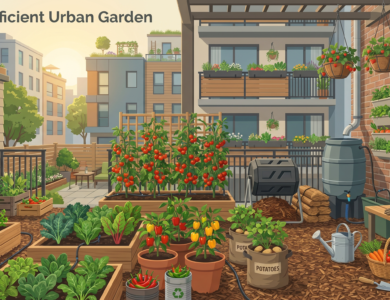
When we say “small space,” we’re talking about anything from a 20×20 foot garden to a couple of raised beds along the side of a house. Even a collection of containers on a sunny balcony can yield serious results with the right methods.


Amish families with just a quarter acre routinely produce enough food to feed six to eight people without store-bought fertilizer, machinery, or even running water. They rely on layout, crop choice, and daily attention. You don’t need a full homestead to grow food like this. You need a mini homestead mindset focused, intentional, and fiercely practical.
If you’ve got:
- 100 to 200 square feet of growing space
- 4 to 6 hours of sunlight per day
- Basic tools and access to compost
You’ve got enough to grow most of your produce. Add in food preservation techniques and smart planning, and you’re on your way to true food independence.
Key Amish principles for food self-sufficiency
Soil health is everything (compost, cover crops, manure)


Ask any Amish farmer what the most important part of gardening is, and they won’t hesitate: soil. Rich, living, well-fed soil is the backbone of everything they grow. The Amish don’t treat soil like dirt. They treat it like life itself.
Their gardens begin with organic matter. Kitchen scraps, animal manure, rotted hay, and shredded leaves are turned into thick, black compost through time and care. Nothing is wasted. Everything returns to the soil. And the payoff is real. Healthy soil holds moisture, feeds microbes, and produces more nutrient-dense crops with fewer problems.
Cover cropping is another pillar. After harvesting one crop, Amish gardeners often plant fast-growing species like buckwheat or clover. These protect the soil from erosion, add nitrogen, and help break up compaction. Come spring, those crops are cut back and composted right in place, enriching the bed for the next round.
Animal manure, especially from horses, chickens, and cows, plays a major role. But it’s never used raw. Amish gardeners allow it to age for months in piles or mix it with bedding and plant debris. By the time it’s worked into the soil, it’s a safe, powerful amendment full of beneficial microbes.
There are no synthetic fertilizers here. Just patience, biology, and a relationship with the land.
Focus on heirloom, nutrient-dense crops
The Amish aren’t chasing trends. They’re saving seeds from plants their great-grandparents grew. These are heirloom varieties open-pollinated, time-tested, and often more resilient than commercial hybrids. They may not grow as fast, but they’re rich in nutrients, flavor, and genetic diversity.
Crops like Cherokee Purple tomatoes, Golden Bantam sweet corn, and Calico pole beans fill their gardens. These plants have adapted over generations to local conditions, making them more reliable in unpredictable weather.
And it’s not just about taste. Heirloom crops tend to be more calorie-dense and better suited for storage. Amish gardeners prioritize root vegetables, squash, beans, and corn foods that can be dried, canned, or stored for winter without refrigeration.
Choosing the right crops is about more than what grows. It’s about what feeds a family long-term. That’s the quiet genius behind Amish gardens: they grow what matters.
Planting by the signs and the seasons
Modern gardening apps might tell you when to plant. The Amish use the sky. Moon phases, temperature shifts, and years of observation guide their decisions. They believe certain crops perform better when planted at specific lunar stages. For example, leafy greens during the waxing moon, root crops during the waning.
They also plant in harmony with the seasons, never forcing growth out of sync. In spring, they sow cool-hardy plants like peas, lettuce, and brassicas. As temperatures rise, they transition to corn, tomatoes, and beans. Come fall, they return to kale, carrots, and overwintering garlic.
This rhythm keeps the soil in balance and the gardener in tune with nature. It also helps avoid common problems like bolting, pest surges, and disease outbreaks. Instead of fighting nature, Amish gardening flows with it.
Each season is respected for what it gives. There is no rushing. Only observation, adaptation, and trust in the cycle.
High-yield gardening in small areas


Raised beds and intensive planting
Raised beds are a cornerstone of small space gardening. The Amish may not build them with fancy lumber or decorative edges, but the principle is the same. A well-formed bed, slightly elevated and filled with rich soil, becomes a powerhouse of productivity.
Why do raised beds work so well? First, they warm up faster in spring, allowing earlier planting. Second, they drain better, which prevents root rot and compaction. Third, they let you concentrate compost and nutrients exactly where plants need them.
But the real magic comes with intensive planting. In a traditional row garden, much of the space is wasted on walking paths. The Amish eliminate that waste. They plant crops closely, using tight spacing to shade out weeds, retain moisture, and maximize yield per square foot.
For example:
- Lettuce and spinach can be sown just 4 inches apart
- Carrots can be grown in dense rows without thinning
- Bush beans can be tucked around taller crops like corn
This method requires careful soil management and consistent watering, but when done right, it produces astonishing results. An 8×4 foot bed, managed intensively, can yield more than triple the harvest of the same space in a traditional layout.
And the beauty? You don’t need fancy gear. Just a spade, compost, and a bit of planning.
Companion planting for space and pest control
The Amish don’t spray synthetic chemicals to fight pests. Instead, they rely on the natural synergy between plants. Companion planting is the practice of growing certain crops together to boost growth, reduce disease, and repel insects.
It’s an old-world technique, but it works just as well today. Take the “Three Sisters” method corn, beans, and squash grown together. Corn provides a pole for the beans, beans fix nitrogen for the soil, and squash shades the ground to suppress weeds. It’s a perfect ecosystem in a single bed.
Other favorite combinations include:
- Tomatoes with basil and marigolds (to deter hornworms)
- Carrots with onions (onions repel carrot flies)
- Cucumbers with dill and nasturtium (which attract beneficial insects)
This style of planting also allows for layering. Tall crops grow upward, mid-height crops fill the center, and low growers cover the soil below. The result is a lush, living patchwork that looks chaotic but functions with incredible efficiency.
It takes time to learn which plants play well together, but once mastered, it turns your garden into a self-balancing system less weeding, less spraying, and more food.
Vertical gardening the Amish way
Space is limited. The Amish know that, and they’ve been growing up as well as out long before the term “vertical gardening” went mainstream.
Poles, trellises, fences, and simple wooden A-frames are used to lift vining crops off the ground. Cucumbers, beans, peas, and even squash varieties are trained to grow vertically. This frees up valuable ground space while increasing airflow and reducing disease.
In tiny gardens, vertical growing is the difference between a harvest and a haul. A single trellis can double or triple your output, turning empty airspace into a living wall of food.
The Amish often build these supports from what they have on hand branches, twine, salvaged boards. No plastic, no imported kits, just simple, effective structures.
The key is choosing the right varieties. Look for:
- Pole beans instead of bush
- Indeterminate tomatoes
- Vining cucumbers and squash
- Climbing peas and melons
These crops respond well to vertical support and produce more when trained correctly.
In small space gardening, vertical systems are not just helpful. They are essential. And no one does it more naturally or more effectively than the Amish.
Planning and planting for a full year of food
Garden layout for maximum productivity
A small garden can feed a family for an entire year if it’s laid out with intention. The Amish never plant randomly. Every row, every bed, every trellis has a purpose. Space is treated as sacred, and every inch is expected to give back.
At the core of their layout strategy is zoning. High-yield, high-maintenance crops like tomatoes, lettuce, and green beans are planted closest to the home or main path. These need regular attention. Further out, you’ll find storage crops like potatoes, onions, and winter squash that need less daily care.
Beds are oriented to take full advantage of sunlight. North–south rows allow even light distribution, minimizing shade and maximizing growth. Paths between beds are kept narrow just wide enough for a wheelbarrow or bare feet to leave as much room as possible for growing.
The Amish also use companion crops to stack production in a single space. A central tomato cage might be surrounded by lettuce and radishes early in the season, then replaced with basil and carrots as the summer progresses. Nothing sits idle.
Careful layout is not just about yield. It also reduces labor, simplifies watering, and keeps pest pressure in check. Thoughtful design creates a garden that works with you, not against you.
Succession planting and rotation (backyard survival garden)
One of the biggest mistakes in backyard gardening is harvesting once and then letting the bed sit empty. The Amish avoid this with succession planting a technique that keeps food growing in waves throughout the season.
As soon as one crop is harvested, another goes in. Spring lettuce is followed by bush beans. Early potatoes are replaced with fall broccoli. Spinach gives way to carrots. This rhythm ensures that the soil is always producing, never resting.
Rotation is equally important. Crops are grouped by family like brassicas, nightshades, legumes, and roots and moved to new beds each year. This prevents nutrient depletion, controls disease, and supports better overall health.
The Amish don’t rely on spreadsheets. Their system is rooted in habit and memory. A simple notebook, a wall calendar, and years of observation are often all they need to rotate effectively.
In a small garden, this kind of management is what makes full food self-sufficiency possible. It stretches the growing season and multiplies the harvest without needing more space.
Year-round planning with seasonal charts
Amish gardeners think in seasons, not months. Their calendars aren’t filled with appointments, but with planting dates, harvest windows, and preservation goals. They plan backward from winter to make sure every season is feeding the next.
In early spring, they prioritize fast-growing greens and roots that can handle cold soil. As the weather warms, they shift to summer staples corn, tomatoes, cucumbers, peppers, squash. Fall brings another round of hardy crops and storage vegetables like beets, cabbage, and leeks.
Winter isn’t idle. It’s for planning, seed saving, and tending cold frames. It’s when root cellars are stocked and pantry shelves filled. The work continues, just in a quieter form.
Using seasonal charts tailored to your region helps mimic this approach. Sketch out your planting plan in advance. Track sowing dates, days to maturity, and expected harvests. Note what worked and what didn’t. This process turns your garden into a living system that gets better every year.
Growing a year of food isn’t about growing everything at once. It’s about steady, thoughtful steps aligned with nature, timed with care, and repeated with trust.
Food preservation and storage like the Amish
Root cellars and cold storage
Growing food is only half the equation. The other half is keeping it. The Amish rely on proven low-tech methods to store their harvest through the winter, and at the center of it all is the root cellar.
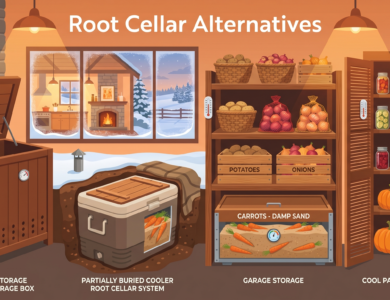
Root cellars are cool, dark, and humid. They’re often dug partially underground or built into a hillside, where the earth naturally regulates temperature. This stable environment keeps potatoes, carrots, beets, turnips, onions, and apples fresh for months without electricity.
Shelves are lined with straw-filled boxes. Crops are layered with sand or sawdust to prevent moisture loss and spoilage. Airflow is carefully managed. Even in homes without a traditional cellar, cool closets, back porches, or unheated pantries are adapted to serve the same purpose.
Cold storage is not limited to underground spaces. In Amish communities, back rooms of barns or insulated sheds are used for storing jars, bins, and baskets of preserved food. The goal is simple: extend the harvest, reduce waste, and rely less on modern refrigeration.
With thoughtful design and insulation, even urban or suburban families can create small-scale versions of these systems. A repurposed garage, an old wine cellar, or a converted basement corner can become a food-saving powerhouse.
Drying, fermenting, and canning methods


The Amish don’t own chest freezers. Instead, they lean into timeless preservation methods drying, fermenting, and canning passed down over generations.
Drying is one of the simplest. Herbs, hot peppers, apple slices, beans, and even tomatoes are air-dried on screens or hung in bundles. Some families use solar dehydrators built from scrap wood and old windows. Once dried, foods are stored in jars or cloth sacks, ready for winter stews and teas.
Fermenting is another essential skill. Cabbage becomes sauerkraut, cucumbers become pickles, milk becomes yogurt or soft cheese. These probiotic-rich foods not only preserve nutrition but actually improve it. Amish kitchens often have entire shelves devoted to crocks, jars, and bubbling jars tucked under towels.
Then there’s water-bath and pressure canning. In late summer, Amish homes smell like boiling tomatoes and stewed peaches. Jars are filled, sealed, and labeled for use months later. Low-acid foods like green beans and meats are pressure-canned to ensure safety.
Preservation is not a one-size-fits-all approach. It’s about knowing your crops and choosing the right method for each one. The result is a pantry filled with diversity: dried herbs, canned soups, pickled beets, fruit preserves, and shelves of homemade staples ready for any season.
Using a backyard pantry
Amish homes often have a dedicated pantry usually a cool, dry room off the kitchen with floor-to-ceiling shelves. But the pantry is more than a room. It’s a mindset.
Every crop grown has a purpose and a place. Excess is intentional. Nothing is wasted. What isn’t eaten fresh is processed, labeled, and stored. The pantry becomes the family’s grocery store, built by hand over months of planning and work.
This approach can be adapted in any home. A few wire shelves in a closet. Wooden racks in a hallway. Even clear bins under a bed. What matters is not the size of the space, but the intention behind it.
Keeping inventory is key. Amish families use handwritten logs or wall charts to track what’s on hand and when it was stored. This prevents waste and helps guide future planting decisions. If canned carrots ran out in February, next year’s crop might need to double.
The pantry is more than storage. It’s freedom. It’s food security. It’s the quiet assurance that no matter what happens outside weather, prices, shortages your family will eat well.
Real examples: families growing a year of food in tiny lots
In a world filled with marketing claims and social media filters, real-life examples matter more than ever. Fortunately, across the United States, families are quietly putting Amish-inspired gardening principles into practice on rooftops, in suburban backyards, and even on rental properties growing a year’s worth of food in spaces most people overlook.
One such example is the Jensen family in Ohio. With a modest 25×30-foot backyard, they’ve managed to grow nearly 2,500 pounds of food in a single year. Their garden includes six raised beds, a trellis wall along the fence, and a compost pile made from salvaged pallets. They keep no livestock. Their only tools are a wheelbarrow, a spade, and time.
Their secret is routine. Every Sunday, they plan the week’s tasks sow, harvest, prune, mulch. Every square foot of space is managed like a miniature farm. They grow crops in succession: radishes in spring, followed by green beans, then fall spinach. Even their fence posts support climbing peas and pole beans.
Another story comes from Mariah, a single mother in Pennsylvania. With only a front yard and a few container beds, she built a “vertical homestead” using shelves, buckets, and trellises. By focusing on calorie-dense staples like potatoes, squash, and beans and preserving aggressively she was able to feed her daughter entirely from their small-space garden for over nine months. She stores canned tomatoes under her bed, hangs dried herbs from curtain rods, and uses her porch as a solar dehydrator.
In North Carolina, a retired couple transformed their townhome’s backyard just 300 square feet into a highly productive mini homestead. They built raised beds edged with cinder blocks, grew dwarf fruit trees in pots, and planted intensively. With a homemade cold frame and early starts indoors, they managed four seasons of food. Their pantry holds enough jars to last until next spring, and their grocery store visits have dropped to once a month, mostly for coffee and flour.
These are not wealthy families with acres of land or access to commercial greenhouses. These are everyday people using thoughtful design, Amish-inspired principles, and grit to produce real, practical results. They’re not aiming for perfection. They’re aiming for independence.
The common thread in all these stories is intention. Each gardener started small, learned through trial and error, and kept going. They didn’t wait for the perfect tools or the perfect space. They started with what they had and that’s the most Amish thing of all.
Common mistakes to avoid with small-scale food production
Even with the best intentions, many gardeners set themselves back by repeating avoidable mistakes especially when trying to grow a year’s worth of food in limited space. The Amish avoid these errors through simplicity, discipline, and observation. Learning from them can save you months of frustration and lost harvests.
Overplanting without a plan
It’s tempting to cram every seed packet you own into your garden on day one. But overplanting without a clear layout or seasonal plan leads to wasted space, crowded beds, and poor yields. Plants compete for light, water, and nutrients, and when there’s no space to harvest or replant, your garden becomes more work than reward.
Successful small-space gardening is not about growing everything. It’s about growing what counts. Prioritize high-yield crops, rotate wisely, and leave room for succession planting. Every square foot needs a job.
Ignoring soil health
This is the biggest mistake beginners make. They buy plants, build raised beds, and get excited but neglect the foundation: the soil.
Poor soil leads to weak plants, pest infestations, and disease. Dumping synthetic fertilizer may give a quick green-up, but it won’t sustain your crops long-term. The Amish understand that soil is not just dirt it’s a living system.
Instead of rushing, start with soil. Build it up with compost, manure, mulch, and cover crops. Feed the microbes and the microbes will feed your plants.
Growing the wrong crops for your space
Not every crop belongs in a small garden. Corn, for example, takes up a lot of space and offers a relatively small calorie return unless planted in bulk. Pumpkins and melons can sprawl for yards unless trellised carefully.
Focus on crops that are:
- Nutrient dense
- Easy to preserve
- High yielding per square foot
- Tolerant of tight spacing or vertical growth
Think potatoes, carrots, beans, kale, garlic, tomatoes, and herbs. These give the most back for the space they occupy.
Forgetting to track and adjust
Gardening without observation is like sailing without a compass. You don’t need spreadsheets or fancy apps, but you do need awareness. What worked? What failed? What ran out too early? What rotted on the vine?
The Amish track their gardens with journals, seed tins, and quiet attention. A few notes each season help you refine your plan year after year.
Mistakes are part of the process. But repeating them isn’t. Keep records, ask questions, and stay humble. The garden is always teaching.
Relying too much on convenience
Plastic containers, chemical sprays, cheap soil bags many of these modern conveniences are more crutch than solution. They add clutter, create waste, and often fail when you need them most.
The Amish show us that the best tools are often the simplest: a hand fork, a sturdy hoe, a compost pile built from scrap. Slowing down and relying on what you can build, repurpose, or regenerate often leads to better results.
Self-sufficiency is not about buying your way to abundance. It’s about learning, adapting, and building resilience from the ground up.
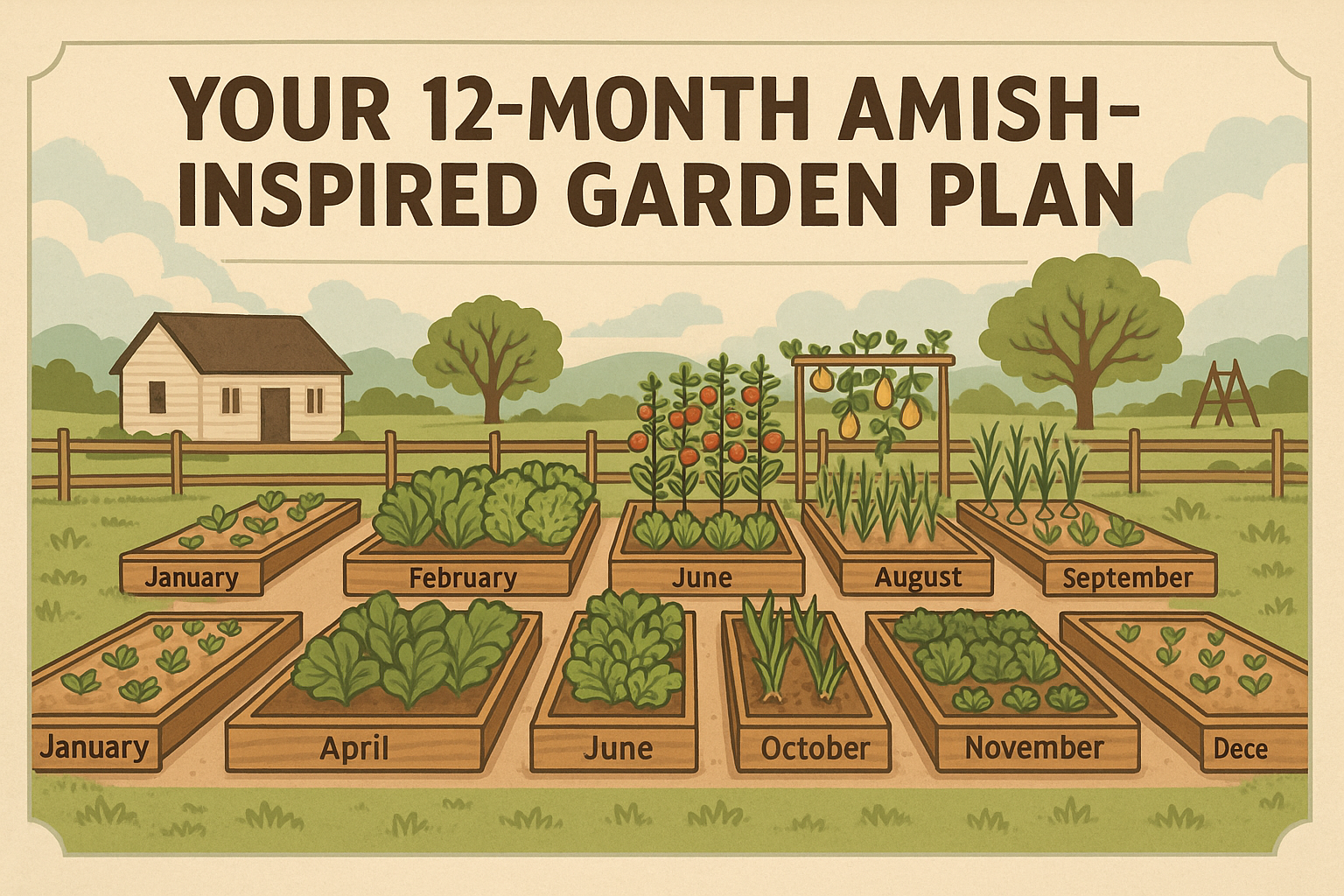
Your 12-month Amish-inspired garden plan (printable checklist)
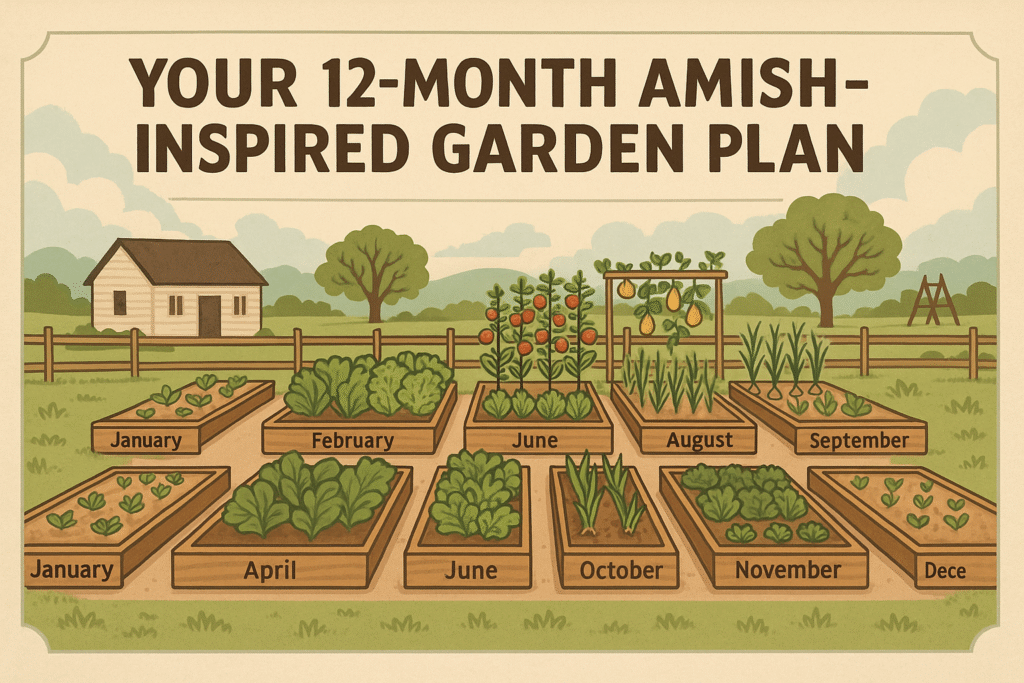
Creating a self sufficient garden isn’t about doing everything at once. It’s about steady, seasonal action. This simplified 12 month plan reflects Amish rhythms and small-space practicality. It’s designed for gardeners working with 100 to 300 square feet, aiming to grow a full year of food in small spaces.
Use this as a reference, hang it on the wall, or add it to your gardening journal.
January
- Review last year’s notes and harvest records
- Plan your garden layout and crop rotations
- Order heirloom seeds from trusted suppliers
- Repair or build garden structures (trellises, compost bins)
- Begin indoor composting if soil is frozen outside
February
- Finalize planting calendar by frost zone
- Start early seeds indoors (onions, leeks, celery)
- Inventory canning jars and preservation supplies
- Prune dormant fruit trees or berry canes
- Turn indoor compost and collect dry browns
March
- Sow cold-tolerant crops outdoors (peas, spinach, radishes)
- Start warm-season crops indoors (tomatoes, peppers, herbs)
- Apply compost to prepared beds
- Set up cold frames or cloches for early starts
- Begin hardening off hardy seedlings
April
- Transplant cool-season starts into raised beds
- Direct sow carrots, beets, lettuce, turnips
- Prepare supports for vertical crops
- Mulch heavily to suppress early weeds
- Check rainwater catchment systems
May
- Transplant warm-season crops outdoors
- Plant succession crops for greens and root veggies
- Start trellising cucumbers, pole beans, tomatoes
- Monitor soil moisture and begin consistent watering schedule
- Thin seedlings and begin first harvests
June
- Harvest spring crops and replant beds immediately
- Sow summer beans, squash, basil, and heat-loving herbs
- Side-dress plants with compost or worm castings
- Watch for pests and apply natural solutions (diatomaceous earth, neem, hand-picking)
- Begin first rounds of drying or canning herbs
July
- Continue harvesting and replanting beds
- Sow late carrots, fall beets, cabbage, and kale
- Deep water in early morning to avoid evaporation
- Maintain mulching, compost pile, and weed control
- Clean and label pantry jars as preservation begins
August
- Pick and preserve tomatoes, cucumbers, beans, zucchini
- Ferment, dry, or can large batches weekly
- Plant last rounds of lettuce, spinach, and green onions
- Monitor for mildew and blight on late summer crops
- Store root crops in a cool shed or garage if space allows
September
- Harvest winter squash, potatoes, onions, apples
- Cure and store crops for long-term keeping
- Sow cover crops (clover, rye) in cleared beds
- Begin fall cleanup of tools, supports, and pathways
- Inventory seeds and start saving from healthiest plants
October
- Finish canning and drying remaining harvests
- Compost garden waste and fallen leaves
- Insulate root storage bins or prepare cellar space
- Plant garlic and overwintering onions
- Review successes and failures of the season
November
- Mulch all beds with straw, leaves, or compost
- Organize tools, sharpen blades, oil handles
- Label and organize seed collections for next year
- Replenish pantry staples from local farms if needed
- Rest and reflect on what the garden provided
December
- Review your food stores and adjust next year’s plan
- Read gardening books or connect with local growers
- Build new raised beds or cold frames indoors
- Begin creating next year’s planting schedule
- Give thanks for the soil, the seasons, and the work
This checklist isn’t just about tasks. It’s about rhythm, observation, and trust. A small-space garden, handled month by month with care and intention, becomes more than productive. It becomes dependable.
How much land do I need to grow all my food?
You don’t need acres. With as little as 200 to 400 square feet, a well-managed garden can provide most of the produce needs for a small family. Success depends more on planning, soil health, crop selection, and preservation techniques than raw space.
If you focus on high-calorie crops like potatoes, beans, carrots, kale, and squash and use succession planting and vertical growing you can get impressive results in even tighter areas. Many urban gardeners grow nearly a full year of food using raised beds in a backyard the size of a parking spot.
Do the Amish use any modern tools?
Most Amish communities avoid electricity and gasoline-powered tools, but they aren’t opposed to efficiency. You’ll often see hand-cranked seeders, sharpened hoes, push carts, root cellars, and clever rainwater systems. Some Amish groups allow solar power or propane for certain tasks.
The key isn’t about being anti-modern. It’s about choosing tools that don’t create dependency or waste. That’s a lesson any homesteader can learn from, whether you live in the countryside or the city.
What are the best crops to prioritize in small spaces?
Focus on calorie-dense, nutrient-rich, and storage-friendly crops. The Amish favor:
Potatoes, Carrots, Cabbage, Dry beans, Onions, Kale, Garlic, Tomatoes, Winter squash.
These crops produce large yields per square foot, can be preserved in many ways, and form the backbone of a self-reliant pantry. Leafy greens and herbs can also be tucked into corners or grown vertically to maximize every inch.
Can I use this method in the city or on a balcony?
Yes, with adaptation. Many of the principles intensive planting, composting, crop selection, succession planting apply just as well in containers or raised beds on a balcony or rooftop. You’ll need to focus more on vertical gardening, soil management in pots, and using available microclimates (like south-facing walls or window boxes).
Even with limited sunlight, you can grow herbs, greens, radishes, and compact varieties of tomatoes, beans, or carrots. Urban food independence might not look like a traditional garden, but it’s still entirely possible.
How long before I become food independent?
It typically takes 2 to 3 seasons of consistent effort to reach meaningful levels of food independence. The first year is for building beds, learning your soil, testing crops, and learning preservation. By the second year, you’ll start optimizing your layout, timing, and harvests. By the third year, most small-scale gardeners have developed a rhythm that produces the majority of their fresh and stored food.
The Amish don’t rush. They build year by year, season by season. If you stay consistent, your garden will reward you first with fresh meals, then with full shelves.